Joze
Plecnik - the Architect
The
architectural legend of Slovenia
Joze Plecnik (1872-1957) holds a special place in the history of
the Slovene nation. He became one of the leading architects of central
Europe, creating innovative work of originality and brilliance that
has outlasted major trends of the period and led to a rediscovery
by the post-modernists. He has been referred to as the "Slavic
Gaudi" (F.Achleitner), an original genius who "created
his own impressionistic legacy - idiosyncratic, hermetic and inimitable"
(W.Singer) and given the apt title of "modern classicist"
(P.Krecic)
Friedrich Achleitner compared Joze Plecnik to Antonio Gaudi: "Like
Gaudi, he inhabits a frontier zone between cultures; he is an 'architectural
fundmentalist', but also an artisan, a technician, an inventor,
and a landmark figure for a newly developed national architecture.
In his work, he was always fully conscious of his ethnic group and
his region, while remaining critical with respect to 'popular' as
well as 'noble' culture, and even able, through extreme self-control,
to integrate emotional phenomena such as kitsch into his field of
reference".
|
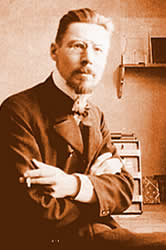 Plecnik 1904,
successful architect in Vienna
Plecnik 1904,
successful architect in Vienna |
Peter
Krecic, the foremost Plecnik expert in Slovenia today sums
up the significance of this great Slovenian architect:
"Plecnik's contribution to the formation of the national
Slovenian ideology of Modernism is substantial, yet it was
also European, even international in scope. There is almost
no form in his art that springs exclusively from Slovenian
vernacular sources. From the end of the 19th century, when
the new cultural and political leaders were at the helm
of smaller stateless nations, there was a widespread search
for national art as a means of achieving cultural legitimacy.
Plecnik felt he should contribute to such aims. In his personal
artistic programme, he consciously sought inspiration in
the classical Slovenian tradition, in the vestiges of antiquity,
in the ancient Emona, in the traces of Italian Baroque found
in Ljubljana. Indeed his entire vision of Ljubljana as the
new Athens was based on his perception of Ancient Rome,
of the Italian renaissance and Baroque periods, and the
Mediterranean. At the same time he never lost his northern
touch, his mystical and mythical self, which he expressed
most eloquently in his realisations in wood. This side of
Plecnik stems largely from the Viennese Secession and Expressionism,
but it also owes much to Slovak and Slovenian rustic tradition.
|
| Thus
Plecnik embodies and reconciles two artistic natures,
two fundamental artistic moods. The meeting between North
and South rightly takes place in Slovenia and particularly
in Ljubljana, its capital. Joze Plecnik in synthesizing
these traditions, natures and moods, should thus be considered
one of the greatest - and possibly one of the last - universal
artists."
Debra Schafter defined Plecnik's work in terms of the
Postmodernist movement and present day viewpoint:
"Plecnik's pluralistic and inventive vocabulary juxtaposes
tradition with innovation in a manner we come to associate
with the postmodern attempts to collapse styles through
a process of appropriation and divestiture. Indeed, like
the architects of the modern era, Plecnik did not use
historical references 'naturally' that are to establish
his monuments as a part of some immediately recognizable
tradition, but 'critically', as a means to revitalize
forms through new and unexpected references. Plecnik reorganized
traditional codes according to new paradigms that could
allow modern concepts regarding structure, function, space
and viewer to take place in a vast cultural, historical
and architectural heritage."
|
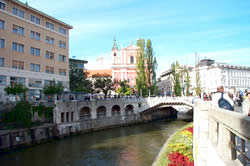 The heart of
Plecnik's Ljubljana:
The heart of
Plecnik's Ljubljana:
the river, the three bridges, the people |
Plecnik was born in Ljubljana, the son of a Slovenian cabinet-maker,
and was to follow in his father's trade and never thought
of becoming an architect. However his talent for drawing
was recognized early, when he received a scholarship at
the newly opened vocational school for industrial arts and
crafts in Graz, Austria. It was the first step toward the
architectural profession. Here he met his first true master,
the architect Theyer, who befriended him and made him his
assistant. With Theyer's help Plecnik moved to Vienna, where
for two years he designed furniture and supervised production
for a large furniture company. He tried unsuccessfully to
enroll at the School of Decorative Arts and frequented museums,
galleries and exhibitions.
The decisive moment
in Plecnik's life occurred, when he saw at an exhibition
Otto Wagner's plans for the new cathedral in Berlin. When
he became Wagner's student, he was on his way towards
an extraordinary career.
As
architect Plecnik was a visionary and a reformer. He was
a pioneer in urban planning, an innovator in the use of
new building materials and their potential for attempting
new structural and ornamental building solutions. While
highly original, experimental and individualistic in his
building designs, he simultaneously sought to incorporate
the historical dimension and achieve a continuity of established
traditions.
During
his career he created architectural masterpieces, leaving
his stamp on three central European capitals - Vienna,
Prague and Ljubljana. They represent three distinct stages
in the development of his genius. In each city he rose
to new challenges and created monumental buildings, which
amazed his contemporaries and are still astonishing today. |
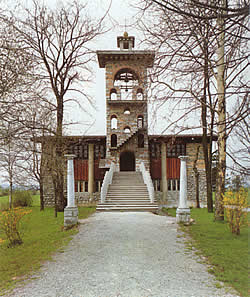
Plecnik's
church St.Michael on Barje.
A beautiful example of Plecnik's architecture,
modest in size, but designed with full mastery
of his craft with novel solutions of structure and materials.
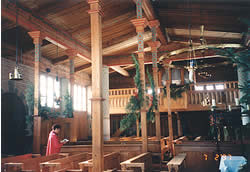
The interior
of St.Michael is entirely carved in wood,
creating a homely, warm, pleasant ambience.
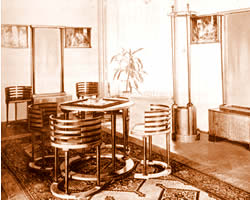
Arrangement of
the waiting room of dr.Peham, 1905
|
In Vienna (1894-1911)
Plecnik completed his studies and made his mark as one
of the most exciting and accomplished secessionist architects
and designers of the time. His Zacherl Palace (1905)
established his reputation as an original, innovative
and brilliant architect - and a foremost exponent of
expressionism.
Prague
(1911-1920) became the arena of Plecnik's most ambitious
and monumental building project, the restoration of
Hradcani; the ancient and massive castle fortress of
Prague. He was appointed The Castle Architect, given
the brief by the President Stefan Masaryk to create
a powerful symbol for the newly emerged Czech nation-state.
The project took 15 years to complete (1920-1935) and
was not only the most monumental but also the most challenging
undertaking of his professional life. The Prague Castle
is a colossal monument to Plecnik's philosophy of art,
a brilliant example of combining tradition and modernity,
and an enduring symbol of Czech nationhood.
While
residing in Prague, Plecnik began regularly to visit
his native country, discovering Slovenian architectural
traditions, particularly the Karst region.
Ljubljana (1920-1957+) began to draw him. It was
the city where he truly felt at home. In 1920 he accepted
a professorship in Ljubljana in preference to a number
of such positions offered to him. He was fifty and at
the beginning of the most mature and fertile period
of his life.
In
1918, when World War I ended, the Austro-Hungarian Empire
broke into a number of nation-states. Slovenia became
part of the Kingdom of Slovenes, Croats and Serbs. German
cultural and political dominance over Slovenia ended.
There was a tremendous upsurge in all the fields of
endeavour for Slovenes, a time for national self-assertion.
Plecnik was able to start work on the most astounding
and enduring legacy of his life's work. His native city
Ljubljana, the cultural and political centre of Slovenia,
became the arena for his deepest desire: to create as
an architect and as a Slovene a worthy capital for the
Slovenian nation.
Plecnik
believed that architecture had an important role in
the life of the individual, the society and the nation.
He saw the need to educate young architects to an awareness
of the social role of architecture. A pedagogue at heart,
his influence is still felt in Prague. In Ljubljana
the school of architecture that he founded is still
thriving on the Plecnik legacy and has produced generations
of exceptional architects. It has been said, that he
would have done the same for The Vienna School of Architecture,
given the opportunity. Certainly Otto Wagner thought
so, with unanimous support of colleagues and students.
In Slovenia Plecnik had the opportunity, rarely given
to a master architect, for the urban development of
a city. He fulfilled it beyond expectations. The legacy
he left to his country has come to be known as - Plecnik's
Ljubljana. With his designs, plans and landscaping he
breathed beauty and style into the city core, covering
the areas of the Ljubljana castle, old and new sectors
of the city, embankments of the river, parks and squares
throughout the city.
|
The
course of Ljubljanica River was a project on its own,
with redesigned and rebuilt bridges, new embankments along
the river and landscaping. There were numerous special
projects - the city squares and parks, which were given
a new stylish appearance: the Tivoli Park, the Congress
Square with Park Zvezda, Tromostovje (The Three Bridges)
and the Market. A number of Plecnik's buildings are Ljubljana's
major landmarks: The National and University Library,
The Church of St.Francis in Siska, Zale, The Church of
St.Michael on Barje, The Baraga Seminary, and The Ljubljana
Stadium. |
During
the decades following the end of World War 2 Plecnik
was regarded as old-fashioned and outmoded, his role
as Head of School of Architecture sidelined. However,
he continued to work till his death, and the socialist
regime on the whole honoured the old master. Then came
the seventies and rediscovery of Plecnik's genius by
the post-modernists with their search for historical
forms and "the lost wisdom" of architecture.
It was a path on which Plecnik had preceded them, finding
interesting and exciting solutions. Plecnik, the "modern
Classicist", presented them with buildings exemplifying
the juxtaposition and tension between the tradition
and innovation. Plecnik's Ljubljana was an outstanding
example of the modern urban vision and creative ethics
- a city that preserved in its older structure important
stylistic predecessors - the ancient Roman Emona, the
Mediaeval town, the Baroque town, the 19th century town.
Plecnik's
work received high acclaim in 1986, with the great retrospective
exhibition at the George Pompidou Centre in Paris. The
exhibition was first taken to Ljubljana, where it had
extraordinary success, then to Madrid, Munich, Karlsruhe,
Milan, Venice, New York and Washington. In USA he was
the first Slovenian artist to create such an impact.
Subsequently the Paris exhibition became the foundation
of a permanent exhibition of Plecnik's work in the Fuzine
Castle in Ljubljana.
Plecnik
was a great artist and a visionary. He was also a great
Slovenian patriot. Plecnik's Ljubljana is a monument to
a man's love for his country and pride in his Slovenian
heritage. We can say today that he lived up to the words
he wrote in a letter to his brother on completing his
first major project, the Zacherl Palace in Vienna. He
hoped for success "for the sake of Slovenia".
At a time when it was not politically correct to be a
Slovene, he demonstrated with his achievements and pride
in his Slovenian identity that a small nation can achieve
greatness. That it is the quality of its people that counts
and not the strength of numbers.
Aleksandra Ceferin,
Thezaurus 2002
My thanks to Dr. Peter Krecic, the Director of the
Architectural Museum of Ljubljana for advice, contribution
towards preparation of the Plecnik articles, and the permission
to use the photographic material in his publications.
|
S
ources: Peter Krecic, Joze Plecnik, DZS, 1992
Peter Krecic, Joze Plecnik - Branje oblik, DZS, 1997
Peter Krecic, Plecnik's Ljubljana, CZ, 1991
F Burkhardt, C Eveno, B Podrecca, (ed.): Joze Plecnik, Architect:
1872-1957, MIT Press, 1989
Slovene Studies, Journal of the Society for Slovene Studies,
No.2 1996

|
|