Joze
Plecnik in Ljubljana (1920-1957+)
"A
world urban-planning phenomenon"
|
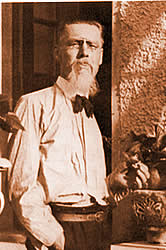 Joze Plecnik
in Ljubljana, 1925
Joze Plecnik
in Ljubljana, 1925
|
Plecnik's arrival in Ljubljana in 1920 inaugurated the third
significant period of his career. He was now 50, at the
peak of his mature powers and approaching the most fertile
period of his life. The decision to settle permanently in
Ljubljana gave direction to the rest of his life and led
to his greatest achievement. Very few artists have the chance
to design large urban areas, much less an entire city. Plecnik
was fortunate in that. Critics have referred to Plecnik's
inventiveness, originality and personal style and described
Ljubljana as the city that bears "the artistic stamp
of one master, signed by the artist."
Peter Krecic, the director of Ljubljana Architectural Museum
and author of several monographs on Plecnik has described
Plecnik's urban planning work in Ljubljana as "a world
urban-planning phenomenon". In
Ljubljana Plecnik succeeded in two chief aims: to found
a Slovenian architectural school, and to make Ljubljana
into a Slovenian Athens and a worthy capital of the nation.
He succeeded in both aims beyond expectations.
|
He
was appointed Head of the Technical School in Ljubljana.
A pedagogue at heart, he was able to satisfy his need to
teach to the full. His development as architect is linked
to his development as teacher, and even today continues
its pedagogical mission. The Ljubljana School of Architecture
has produced many architects of note.
He also succeeded in creating a beautiful, liveable capital
city for Slovenes. One cannot fully understand Plecnik and
particularly his mature work, without his Slovenian background,
which played a major role in his development as architect.
His search for historical forms also meant searching for
traditions within his Slovenian culture. His architectural
mission in "making Ljubljana a worthy capital of Slovenia"
was an essential part of Plecnik and the foundation for
his urban planning work.
|
Ljubljana
is the city where the synthesis between the North (German)
and the South (Roman) is most originally expressed. Plecnik's
nostalgia for Ljubljana after his discovery of Karstian
art and architecture deepened. The study of local architecture
drew him closer to the baroque tradition. He was attracted
to 18th century, a period when artistic influence of Venice
was the key to central Slovenia. The fascinating accumulation
of influences and layers, as well as the Byzantine architecture
of Yugoslavia became the sources of his inspitration.
The
first major project that inaugurated Plecnik's plans for
Ljubljana, was the Church of St.Francis in Siska (1925-1927).
With this grandiose and astonishing building, the architect
introduced into Ljubljana a new set of dimensions and
a new standard of building on a grand scale. It amazed
the city and created some resistance. It also started
the most extraordinary and fertile period of creativity
and realization of plans. It was the beginning of the
"urban planning phenomenon" that is Plecnik's
Ljubljana.
From
1920 onwards, while occupied with work on the Prague Castle,
Plecnik designed and built a staggering number of building
projects both within and outside Ljubljana, planned parks
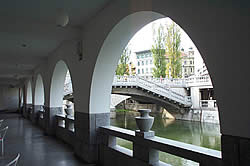
and beautiful city spaces. The work on Ljubljanica embankments
was started in 1931 and completed with some interruptions
in 1939, Tromostovje (The Three Bridges) berween 1930
and 1932. |
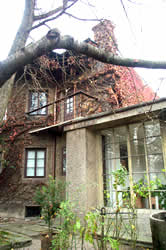 Plecnik's house
in Trnovo, Ljubljana.
Plecnik's house
in Trnovo, Ljubljana.
Today the Architectural Museum of Ljubljana
(photo Sasha Ceferin) |
|
| |
An
integral part of reconstruction was "green architecture",
with weeping willows representing cupolas, poplars representing
columns, hedges are walls, the fresh greenery enhancing
and defining the gently curving waterway within its
deepened riverbed and high embankments. Plecnik gave
the river a series of features, enhancing its function
as an essential artery of city life: through bridges,
which give access and character, through the development
of the Trznica (market) along its bank, and the wonderful
Tromostovje (The Three Bridges) in the very heart of
the city.
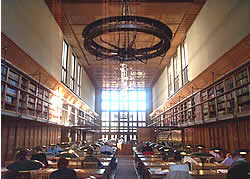
Plecnik's
plans for the National and University Library were completed
by 1931. The work began only in 1936 due to wrangling
with Belgrade about finances. Completed just before
the beginning of World War II, it is the central project
of Plecnik's opus in Slovenia, and reputedly one of
the finest achievements of his artistic maturity. It
is conceived symbolically as a temple of knowledge.
Its long colonnaded entryway portrays the journey from
the darkness of ignorance into the light of knowledge.
Except
for periods of serious disruption and even terror, Plecnik
continued working during the war, designing and planning
everything from monumental plans, such as Ljubljana
Castle to smallest details, building onto his enormous
opus of realized and unrealized projects.
Plecnik's
legacy is a city centre shaped with pavements, copses,
statues, columns and a number of unique buildings, embankments
parks and riverscapes. The National and University Library,
Plecnik's Market, The Three Bridges, have lent character,
distinction and beauty to the city centre.
Among
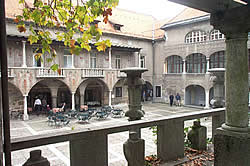
the many buildings and areas designed and built by Plecnik
in Ljubljana are: The Chamber of Commerce, Craft and
Industry (1925-1927), Ljubljana Stadium (1925-1935),
Mutual Assurance Building ((1928-1930), Krizanke (1941),
Congress Square (1927-1941), Tivoli Park (1929-1934),
Baraga Seminary (1938-1941), Ursuline Gymnasium (1939-1941).
At
the centre of Ljubljana is the Tromostovje, connecting
the old city and the new, its living heartbeat. The
whole areas along the river Ljubljanica embankment,
the city squares, the bridges, the Tivoli Park and the
streets leading outwards were gradually restored and
embellished with new pavements, single trees and plantations,
columns, lamps, monuments, bridges and embankments,
gradually creating wonderful living and strolling spaces.
Plecnik was interested in creating social and sociable
spaces, spaces for the people, such as churches and
markets, and to make them pleasant as well as aesthetically
pleasing. It is a strong part of Slovenian culture to
honour their departed and make their final resting place
beautiful with memorial stones and flowers. Plecnik
created the beautiful Garden of all Saints, which became
known as Žale (the place of mourning). It is a
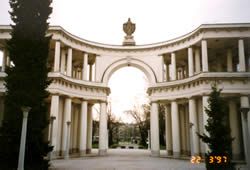
serene and beautiful place, consisting of administrative
premises, two storeyed and colonnaded, the composition
divided by the ceremonial portal in the centre. In the
axis of the portal is the platform for the speaker,
to the left and right are the 14 chapels, apparently
random, in a variety of architectural styles, from prehistoric
tumuli, classical temples and Serbian medieval architecture
to entirely modern. The hedge of high shrubs and other
ornamental plants create a living, rich, ceremonial
ambience. The place for final parting in his view had
to be a ceremonial, almost ritual space, a place of
consolation and Christian hope rather than sorrow and
despair "a classical garden, a garden with emancipated,
absolute architecture". (Krecic)
|
Plecnik
wanted to retain the historically multi-layered Ljubljana
with its Roman, Medieval and Baroque periods and planned
accordingly. He restored the past and added his own
creations, imbuing the cityscape with his own perception
of pleasant city living.
The
present-day Ljubljana gives expression to what is alive,
enduring and beautiful, blending the traditional forms
and the new; the stone sculptures and the living trees;
the bridges and the flowing river; the many-layered
past and the modern present - a historicist's perception
of time and history, combined with the organic perception
of architecture and art as expressed in building.
|
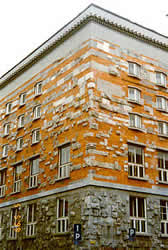
The National
and University Library in Ljubljana,
his most significant building in Ljubljana
(photo Sasha Ceferin)
|
|
Aleksandra
Ceferin, Thezaurus 2002
My thanks to Dr. Peter Krecic, the Director of the
Architectural Museum of Ljubljana for advice, contribution
towards preparation of the Plecnik articles, and the permission
to use the photographic material in his publications.
|
S
ources: Peter Krecic, Joze Plecnik, DZS, 1992
Peter Krecic, Joze Plecnik - Branje oblik, DZS, 1997
Peter Krecic, Plecnik's Ljubljana, CZ, 1991
F Burkhardt, C Eveno, B Podrecca, (ed.): Joze Plecnik, Architect:
1872-1957, MIT Press, 1989
Slovene Studies, Journal of the Society for Slovene Studies,
No.2 1996
 
|
|