Joze
Plecnik in Prague (1911-1920)
The
Castle Architect - Monument to Czech Nationhood
After
arriving in Prague, Plecnik was appointed to a teaching position
at the Prague School of Applied Arts. For the first time he received
a regular salary, had the benefit of university vacations and was
able to devote more time to his present interest - the studies of
Slavic art.
|
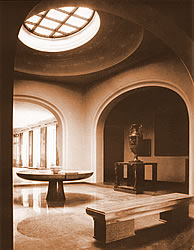 Hradcani, Presidential
Residence designed by Plecnik
Hradcani, Presidential
Residence designed by Plecnik |
On
his retirement, he replaced Jan Kotera as the Head of
the School of Applied Arts, and in the words of Paval
Janak reoriented the school's revolutionary modernity
toward a "mature modern classicism".
Plecnik
was an inspiring teacher, successfully blending in his
approach, classic and modern pedagogic principles:
"The
important thing is not who is guiding the student. A master
has but one obligation: to help his student to learn,
to see and to discover…"
In 1914
Plecnik, along with Kotera, Gocar and Kamil Hilbert, was
among the founders of Spolecnost Architectu, an association
of architects opposed to the official academicism of Czech
architecture. The works produced at the school and published
at the end of 1912 in Spolecnost Architectu journal are
an interesting mixture of the classical (in the style of
Plecnik), the patriotic (focusing on the nationalist theme)
and of cubism (representing the avant-garde). |
|
|
|
During
the war years Plecnik could not expect any important commissions
during this time. He turned his attention to decorative
arts, and involved himself in the craft of gold- and silversmith.
He travelled extensively in Slovenia, particularly the
Karst region, and for the first time became thoroughly
acquainted with the art of his country. He grew concerned
that the lack of sensitivity of foreign architects was
causing Ljubljana to lose its character, acquired over
the centuries from proximity to Italy, and began reflecting
on the capital's city planning problems. It was period
of maturation for Plecnik, giving way to an intense desire
to return permanently to Slovenia.
|
The
end of World War I (1914- 1918) saw the breaking up
of the Austro-Hungarian Empire and the emergence of
new nation-states - Czechoslovakia, Hungary and The
Kingdom of Slovenes, Croats and Serbs (later renamed
Yugoslavia). Proud of their nationhood, the new states
were anxious to start reconstruction with great buildings
and the establishment of schools of architecture.
Plecnik, by then an architect of considerable renown,
was offered professorships in Prague, Ljubljana, Belgrade,
Berlin and Zagreb.
Before
he made up his mind, a new challenging offer caused
him to delay his decision. Tomas G. Masaryk, President
of the Czech republic was addressing the problems
of urban development in the capital and the long overdue
restoration of the Prague castle. He wanted the castle
with its rich historical tradition to become the national
symbol of the young republic.
Plecnik
was first appointed as a member of the jury for the
competition, chosen for his plan of Garden of Paradise
and finally appointed the Castle Architect with the
brief of restoring the ancient fortress.
Masaryk
was looking for an inspired creator whose architectural
design could express the very values on which the Czech
state was based. Prague had become the capital of the
newly established Czechoslovak republic and needed a
striking monument as centrepoint and expression of its
newly founded nationhood.
Tomas Masaryk saw in Plecnik the visionary genius with
skill and ideas to realize the concept. He noted in
his 1925 declaration:
"The
nation regards the castle as a national monument, hence
we must transform a castle intended for the monarch
into a democratic castle."
|
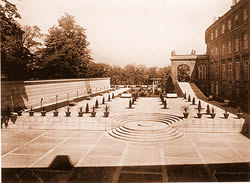
The Paradise
Garden of Hradcani designed by Plecnik
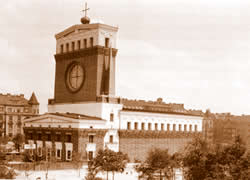
The Church of
the Sacred Heart of Jesus in Vinohradi, |
| |
|
He
understood and shared Plecnik's ideas of blending the
classical with the modern, and drawing on ancient tradition
as expression of national identity.
Plecnik's
work on the Prague Castle - Hradcani was a watershed and
the most monumental architectural project of Plecnik's
career. None of Plecnik's creations can compare in importance
and breadth to the restoration of Prague Castle. He shaped
Hradcani into the great national monument of the Czech
state. He did away with centuries of accumulated additions,
removed restricting walls, opened stunning vistas onto
the city, laid magnificent gardens, designed monumental
staircases and gateways, remodeled the President's residence
and filled the place with national symbols.
The
work was monumental in conception and scope, and intensely
satisfying to Plecnik. However his restoration work was
too drastic and innovative to be understood or appreciated
by the general public and he had to withstand constant
attacks in the media.
His
work on Hradcani occupied him for 15 years (1920-1935).
He moved to Ljubljana in 1920, but returned to Prague
each year during the vacations, working with zest and
enthusiasm. The Prague Castle
remains an enduring and extraordinary monument to Czech
nationhood and Plecnik's genius.
Aleksandra Ceferin,
Thezaurus 2002
My thanks to Dr. Peter Krecic, the Director of the
Architectural Museum of Ljubljana for advice, contribution
towards preparation of the Plecnik articles, and the permission
to use the photographic material in his publications.
|
S
ources: Peter Krecic, Joze Plecnik, DZS, 1992
Peter Krecic, Joze Plecnik - Branje oblik, DZS, 1997
Peter Krecic, Plecnik's Ljubljana, CZ, 1991
F Burkhardt, C Eveno, B Podrecca, (ed.): Joze Plecnik, Architect:
1872-1957, MIT Press, 1989
Slovene Studies, Journal of the Society for Slovene Studies,
No.2 1996
 
|
|