Joze
Plecnik in Vienna (1894-1911)
"A
synthesis of extremes - avant-garde and tradition"
|
Plecnik was
to follow in his father's footsteps as cabinet maker.
He did not do well in his academic studies in lower
gymnasium, however he was rather good at drawing and
won a scholarship to the state school for industrial
arts and crafts in Graz, Austria. There he developed
his talent for draughtsmanship and eventually graduated
in fine carpentry and furniture. He first assisted his
mentor Leopold Theyer and later worked for the factory
owner J.W. Muller. Then came the experience that gave
his life a new direction. At an exhibition he saw the
plans of the leading Vienna architect Otto Wagner in
Vienna and enrolled to study under him in 1896. He worked
hard and was soon on the way to the top of the class.
The
Viennese period, comprising his studies and discovery
of classical architecture, was marked by the search
for his own style and architectural concepts. Plecnik
declared as early as 1902:
"I yelled - now I am no longer
yelling; I search for myself wherever I happen to be.
Like a spider, I aim to attach a thread to tradition,
and beginning with that, to weave my own web."
Study
and work in Otto Wagner's studio marked the first period
of his professional life in Vienna. His studies culminated
in the winning of a major graduate competition, which
enabled him to travel to Italy. The competition was
regarded as the first significant victory for the secession
movement. For Plecnik it was of greatest importance,
since it brought him face to face with classical architecture.
It was a turning point in Plecnik's development as architect.
Subsequently he would always combine the timeless, the
traditional and historical with the innovative, experimental
and modern - defining him as the "modern classicist".
His work during the Vienna period is regarded as a major
contribution to the foundations of modern European architecture.
In his exceptional opus of Vienna sketches, which were
partly intended for realization, partly entirely imaginative,
he translated secessionist lines into dramatic expressionism.
His sketches and realized work established him among
the best designers of the time in Vienna.
Plecnik
was invited to participate in a number of major building
projects, then came the great challenge. He was commissioned
with designing and building the monumental Zacherl Palace
(1903-1905) in central Vienna. Plecnik burst like a
comet into public notice and fervent acclaim. He was
now established as the foremost Art Nouveau exponent
and expressionist.
|
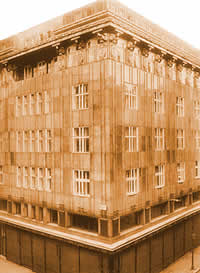 Zacherl Palace
(1903-1905) was Plecnik's first major
Zacherl Palace
(1903-1905) was Plecnik's first major
independent commission. It established him as the foremost
Art Nouveau exponent of central EuropePlecnik
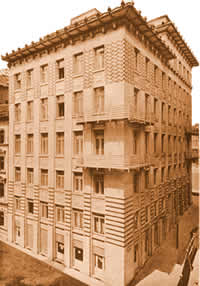
Plecnik was commissioned to renovate Langer House.
It demonstrates exciting new ornamental
techniques on the façade. |
|
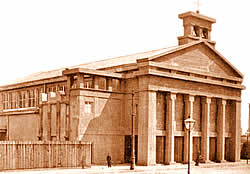
The Church of Holy Spirit in Vienna,
a milestone in modern sacred architecture.
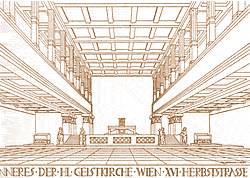
The
Church of Holy Spirit in Vienna,
a sketch of the interior
|
The
avant-garde celebrated it as a victory of modern spirit
- "a synthesis of the extreme avant-garde and tradition".
In his preceding renovation work on the Langer House
and the design of the Zacherl House, he demonstrated
that it is possible to individualize the façade
artistically as a unique part of the architecture which
can bear personal personal concepts, a note on materials,
construction and structural cover of the building. Thus
he executed the Zacherl Palace façade in polished
granite with rich cornices of telemons and the arrangement
of the roof elements. For the Langer House he created
a scrolled and wreathed façade with embossed
windows and balconies. He worked on a number of other
buildings and created contemporary designs for furniture
and household fittings.
Plecnik
undertook one more monumental and innovative building
project in Vienna. He had discovered the early Christian
architecture and started thinking about ways of reforming
the modern sacred building. The outcome was the Church
of the Holy Spirit in the workers' suburb Ottakring
(1910-1911). The church came to be regarded as a milestone
in modern sacred architecture, particularly for his
pioneering use of concrete to reproduce such complex
architectural elements as cupolas and vaults. It was
not the kind of church the general public or some of
the authorities were ready for, and it incurred considerable
public resistance and animosity.
Otto Wagner named Plecnik, now a successful freelance
architect, his successor as Head of Academy of Fine
Arts. The proposal was supported unanimously by colleagues
and students and subsequently repeated three times.
His nomination was rejected primarily due to the opposition
of Prince Ferdinand, who regarded the Slovenian architect
as a subversive Slovene nationalist and dislike his
style as "Slavic" and "barbarian".
|
In 1911 Plecnik decided to leave Vienna. He accepted an
invitation from Jan Kotera the leading Czech architect,
for a teaching post in Prague.
|
| Aleksandra
Ceferin, Thezaurus 2002
My thanks to Dr. Peter Krecic, the Director of the
Architectural Museum of Ljubljana for advice, contribution
towards preparation of the Plecnik articles, and the permission
to use the photographic material in his publications.
|
S
ources: Peter Krecic, Joze Plecnik, DZS, 1992
Peter Krecic, Joze Plecnik - Branje oblik, DZS, 1997
Peter Krecic, Plecnik's Ljubljana, CZ, 1991
F Burkhardt, C Eveno, B Podrecca, (ed.): Joze Plecnik, Architect:
1872-1957, MIT Press, 1989
Slovene Studies, Journal of the Society for Slovene Studies,
No.2 1996
 
|
|