Hrastovlje:
Gothic monument of Slovenia
A
merging of Religion, Art and History
|
|
|
Hrastovlje (pron. hrastovlye) is the name of a small ancient
village in the coastal region of Slovenian Istria. In Slovenian
language it means the place of oaks. Since the discovery
in the fifties of the Gothic frescoes under several coats
of white paint, the name has come to mean the 12prev
century village church standing on the slopes above the
village. The discovery of the Death Dance- usually referred
to as Dance macabre - a rare, well preserved, and complete
example of one of the most famous images of medieval iconography,
has established the church of St.Trinity at Hrastovlje as
one of the most significant cultural monuments of Slovenia.
The Hrastovlje church cannot be measured by the standards
set for great architectural or artistic accomplishments
of the Middle Ages. Nonetheless, hovering between the great
and the commonplace, it exhibits a wealth of gothic iconography,
so that it stands in class of its own. A beautiful surviving
monument of a bygone era has been preserved in all its magic
of stone structures and spaces filled with stories, figures
and vibrant colours. |
|
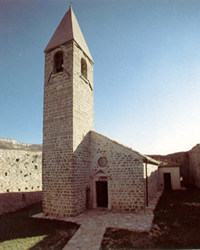
Plate
2: The 12prev century church of St.Trinity at
Hrastovlje
|
|
| |
|
|
The location
of Hrastovlje is unique, the first view astonishing and
enchanting. The ancient structure stands on a gentle rise,
open to view from all sides and from far away, with the
tremendous rocky wall of the Karst country as its backdrop.
We see a great encircling wall, the top of the bell tower,
just visible, rising from its centre. On approach the
walls appear immense, towering mightily with cut, age-mellowed
stone, the church itself completely hidden from view.
It is only revealed on entrance, where the visitor is
confronted with a beautiful, harmonious structure of tall
bell-tower and nave, built of age-mellowed cut stone.
To the astonished eye it appears like a pearl emerging
from its shell.
Dating back to the 12prev century, the church
is Romanesque in architectural style. It is the only example
of Romanesque architecture in Slovenia, preserving an
ancient tradition - with elements of the Eastern European
- far into Middle Ages.
|
|
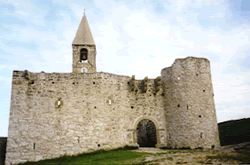
Plate
3: The protecting walls of Hrastovlje
|
|
| |
|
Except for
the vestry, added in 1896, the church as a whole remains
entirely uniform. The exterior of the church shows a beautiful
structure of cut square stones, laid in horizontal layers.
A brick roof of Spanish tiles has been replaced in 1961
with large stone slabs, the traditional roofing of the
Mediterranean regions. The original medieval windows were
replaced in 1663 and the main entrance in the year 1776.
The wall that is such a dominant
feature today was built in the 16prev century,
to provide a stronghold and refuge for the surrounding
villages against raiding Turkish troops - about 90 raids
in the years 1469 to 1559. The eight metres wall, still
whole and sturdy after four centuries, was equipped with
corner towers and wooden passages on three levels. A high
place, strong walls and determined defenders were usually
enough to discourage the raiders.

Plate
1: The famous Hrastovlje fresco: Death Dance or Danse
macabre.Young and old, rich and poor all led to the final
equalizer – the grave.
The great wonder of Hrastovlje is the interior of the
church. The frescoes were discovered in the fifties, under
several coats of whitewash. When the long, difficult and
painstaking work of removing the paint was completed,
the little church presented an exceptionally complete
and well-preserved example of Gothic church art.
The name of the painter who
was commissioned to paint Hrastovlje is known. This was
an exception at a time when small village churches were
painted anonymously by craftsmen who reproduced conventional
figures of religious iconography. He was Master Janez
iz Kastva (magister Johannes de Castua) who was associated
with the well-known Castua painting school and was known
for his individual style through work in the churches
of the region. He received commission to paint Hrastovlje
in 1482 and completed it in 1490. We know this from the
inscription:
This work was completed on
St. Margaret’s day 1490 A.D…Hoc opus fierit
fecit Tomic Vrchovich de… magister Johannes de
Castua pinxit."
The information is written
in two languages, Slovenian and Latin. It is one of the
wonders of Hrastovlje that the Slovenian text is written
in the old Slavic Glagolitic script, the evidence of its
continuing use by the common people up to the 17th
century.
Aleksandra
Ceferin, Thezaurus
|
S
ources: Hrastovlje by Marijan Zadnikar (Ljubljana 1995)
Ars Sloveniae, Gotsko stensko slikarstvo by France Stelè (Ljubljana,
1972)
All photos from Hrastovlje by Marijan Zadnikar,
Except Pllate 3: Aleksandra Ceferin 
|
|