Hrastovlje:
Gothic monument of Slovenia
|
|
Frescoes
of Hrastovlje
Historically
and geographically the Gothic paintings of Hrastovlje
are placed in the subalpine belt of middle Europe, one
of the most interesting areas towards the end of Middle
Ages. The art historian F. Stelè has defined the area
precisely as beginning on the Gulf of Genoa, running through
Switzerland, Tyrol, Carnia, Furlania, Carinthia, Slovenia
and ending in Slovenian Istria as far as the Kvarner Bay
(Zadnikar, p.54). In this space and time Hrastovlje frescoes
are exceptional. Despite their average artistic quality,
they stand out for their iconographic wealth, use of colour,
the unique Death Dance, the complete Genesis and the calendar
cycle portrayed for the first time anywhere in Slovenia.
In the opinion of F. Stelè, the painter of Hrastovlje
frescoes achieved a peak of a particular Gothic church
painting style - the synthesis of country painting of
Istria and Karst regions, Socca Valley and Furlania. This
makes the little church of Hrastovlje the representative
and the best of Gothic religious decorative art of this
region.
|
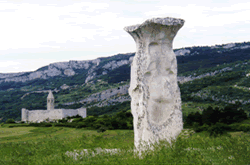
Plate 1: The distant view of Hrastovlje with the 20th
century statue of Ssavrinka, the woman of Istria in the
foreground |
The first
view of the church interior is just as enchanting as
the first glimpse of the Hrastovlje from distance. Step
through the doorway and the eye is assailed by a plethora
of images and warm, rich colours, every space and surface
aglow with familiar images of Christian iconography.
There is no part of walls, ceiling and arches that does
not tell a story or present an allegorical truth.
|
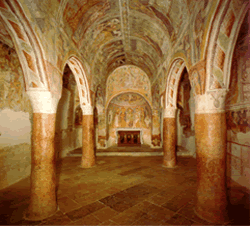
Plate
2:The nave of Hrastovlje Church
|
The
most outstanding painting at Hrastovlje, which raises
it above the commonplace among the examples of Gothic
church art, is the Death Dance or Danse macabre. Painted along the southern
wall, it is among the best preserved paintings of this
well-known medieval theme anywhere. A kind of grotesque
dance with death, it has remained one of the most powerful
and enduring medieval images. Rather rare in medieval
Christian iconography, the Dance appeared in the 15th
century, painted mainly on cemetery walls and carnel houses.
Its origin is not clear. A pictorial reminder of transitoriness
of life and all things material, it also demonstrates
the principle of justice, completely incorruptible and
inescapable for all - young and old, rich and poor, powerful
and powerless. The Hrastovlje Dance of Death has a special
place among the surviving examples. Not the least because
of its excellent preservation and completeness.
|
|

Plate
1: The famous Hrastovlje fresco: Death Dance or Danse
macabre.Young and old, rich and poor all led to the final
equalizer – the grave.
The
frescoes of Hrastovlje church comprise several complete
cycles, exceptional for wealth of imagery. Foremost among
these is the cyclical representation of Genesis, beginning
with Creation, and ending with killing of Abel, which
is rare in its completeness by world standards. There
is the cycle of Christ’s Passion in fifteen
scenes, Mary’s Annunciation and Coronation, the Journey
of Magi and the twelve Apostles ranged in the central
apse behind the altar. Other saints are portrayed in their
various roles as protectors against disease and disaster.
An unusual addition for the Gothic church art is the secular
cycle of twelve months, portraying seasonal activities
and customs of Istria. It is the only case of a secular
cycle in a Gothic church in Slovenia. Two additional months
are added to the yearly cycle of twelve. One of these
portrays a sitting figure with three faces, possibly representing
time (tempus) - past, present and future.
A new and significant viewpoint about the importance of
Hrastovlje frescoes has been added by Marko Pogacnik,
sculptor, earth healer and nature mystic, in his book
The Goddess returns .
In
a chance visit to Hrastovlje, expecting to find in this
place a focal point of energy lines, he found instead
– hidden within the worship of Mary, Mother of God
– a clear representation of pre-Christian Goddess
worship.
His observations are based on an in-depth knowledge
of myth and religion. He found in the figures of Virgin
Mary, Eve and the enthroned skeleton of the Death Dance
a significance that is based on the disposition of the
figures within the church and the path of the sun from
east to west. Added to those aspects is the symbolism
of appearance, attire and surroundings. He identifies
the three figures as the Goddess of Completeness and Creation,
Goddess of Life Forces and Plenty and Goddess of Death
and Rebirth.
One
of the oldest examples of Christian iconography, are two
still lives, an embroidered napkin, a gourd, and a clay
pitcher with a cup, and a piece of cheese and bread. These
two are ranked among the oldest specimens of this kind
of painting in Slovenia, for the Middle Ages were not
in favour of still life painting, preferring the aspects
of the spiritual and supernatural experience.
|
|
One
of the oldest examples of Christian iconography,
are two still lives, an embroidered napkin, a gourd,
and a clay pitcher with a cup, and a piece of cheese
and bread. These two are ranked among the oldest
specimens of this kind of painting in Slovenia,
for the Middle Ages were not in favour of still
life painting, preferring the aspects of the spiritual
and supernatural experience.
There is another preserved element of the past at
Hrastovlje. Under the frescoes, cut into stonework
with a sharp implement are inscriptions records,
notes, signs and signatures. Some record a certain
event or a mass read on particular day. Others wish
to leave permanent sign of their visit. The most
interesting ones express a wish, refer to life’s
hardship, or make a humorous comment. They would
have been written during the 15th and 16th centuries,
before the frescoes were painted over. Most of these
records and "graffiti" are in Istrian
Slovenian dialect; some are in Latin, a few in Italian
and one in German, a fairly comparable population
mix in this region today. The extraordinary thing
is that Slovenian inscriptions are written in the
old Glagolitic
script (glagolica), introduced to the
southern and western Slavs by Byzantine missionaries
Constantine and Methodius in the 9th century. Thus
the Hrastovlje church is, apart from its pictorial
splendour, a unique document of the continuing existence
and common usage of the ancient Slavic script among
the Slovenian country people into the 17th century,
evidence of literacy in their own language.
|
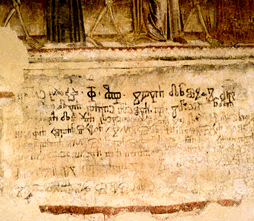
Plate 3: Glagolitic inscription of 1518 in Slovenian
regarding new flooring |
| |
|
|
|
Slovenian
art historians have written a great deal about Hrastovlje.
They agree that it is an outstanding and representative
monument of Slovenian cultural tradition. There are a
number of features which make it exceptional. The church
is the only example of the Romanesque architectural style
in Slovenia. The well- preserved and complete Gothic frescoes,
the glowing colours of the completely painted interior,
the wonderful cyclical representations of the Christian
tradition; the complete and rare Death Dance; the unique
Glagolitic inscriptions; all these make the St.Trinity
Church at Hrastovlje a very special place indeed.
To
the visitor Hrastovlje offers an unforgettable experience,
a marvel of a medieval fairy-tale, with all the wealth
of myth and imagery, distant past, imagination and humanity
in its endless variety. It is an ageless place of simple
faith, innocence and dreams. It is a place to be seen
and experienced and visited again in its wild and beautiful
Istrian countryside.
|
Sources: Hrastovlje by Marijan Zadnikar (Ljubljana 1995)
Ars Sloveniae, Gotsko stensko slikarstvo by France Stelè (Ljubljana,
1972)
All photos from Hrastovlje by Marijan Zadnikar,
Except Pllate 3: Aleksandra Ceferin 
|
|