Traces
of pre-Christian Goddess worship in Hrastovlje
An
interpretation by Marko Pogacnik
|
| The Slovenian
sculptor Marko
Pogacnik has added a new viewpoint to the significance
of Hrastovlje frescoes. A renowned earth healer and inventor
of earth healing process that he named lythopuncture
and nature mystic in touch with the energies that flow beyond
the visible nature, Marko Pogacnik is also an author published
in Slovenian, English and German. His books deal with earth
healing process and new consciousness of the earth and our
planet.
In the frescoes
of Hrastovlje he discovered the representation of
an ancient pre-Christian religion of the Goddess, which
existed in a matriarchal world order, later to be displaced
by the patriarchal.
In his book the The return
of the Goddess he describes the search and the new
awareness he had gained on the way. It is his belief that
mankind suppressed the female principle and in consequence
lost the connection with nature. With the loss of the
Goddess we have also lost the proper feeling and respect
for nature. The exploitation of land, pollution of environment
and all the evils deriving from those, stem from that
initial loss.
In his search for the old
religion of the earth, the nature mystic discovered the
concept of the threefold Goddess – represented by
the girl/virgin, the fruitful woman/mother and the old
crone of death and renewal. In the church of St.Trinity
at Hrastovlje he saw that concept embodied in the figures
of Virgin Mary, Mother Eve and the skeleton of Death Dance.
This is how he describes it.
|
 |
|
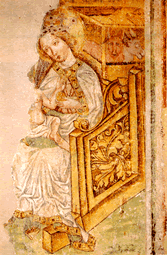
Virgin
Mary with child
seated on golden throne.
|
|
|
|
On the north wall
of the side aisle is a representation of the Magi bearing
gifts. The pageant is moving from the west towards east,
towards the rising sun. There sits the Virgin Mary on a
golden throne with the child Jesus on her lap. She is enveloped
in white mantle with a jeweled border and is wearing a golden
crown. In contrast, the usual representation of Jesus’
birth is a modest stable, with Mary and Joseph kneeling
to the godchild. The two animals painted in the background
of the Hrastovlje fresco serve as a kind of reminder that
the Queen of Heaven is also the Goddess of the earthly sphere.
The indications are unmistakable, that this is the archetypal
White Goddess or Virgin Goddess, who represents the wholeness
of the cosmos, integrating the spiritual and material spheres.
In Hrastovlje she sits in the east, and so represents the
rising sun, a symbol of the new beginning. The magic bloom
decorating her throne connects her with the archetype of
the Goddess of Flowers. The sunrise and springtime are symbols
of rebirth. The Goddess of the Cosmic Completeness has also
given birth to the male principle, symbolized by the godchild
on her lap. |
|
Mother
Eve, representing abundance of life.
|
|
|
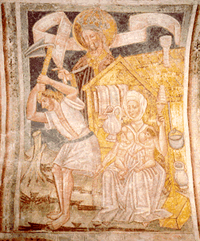
In the middle arch of the
nave we see the figure of Mother Eve, bursting with life-giving
energy. She sits in the centre of her home, suckling two
infants and spinning. In this way Eve of Hrastovlje represents
various aspects of the Goddess. She is the Goddess of
Abundance of Life. Seated in the centre of her home, she
symbolizes the axis, around which are placed all possible
dimensions of creation – the axis of the world. As
the suckling mother, she embodies the source of unlimited
fertility and plenty. Spinning the thread and turning
the spindle, she shares with all manifested beings their
fate, while she guides them through life, death and birth.
Eve of Hrastovlje manifests
another significant aspect of the Goddess of Abundance
of Life. We see her with Adam, as he works the land. Active
yang of Adam, balanced by still, central yin of Eve, signifies
male-female polarization of forces, characteristic of
the red or creative phase of the threefold Goddess. Creativity
originates from the tension between female and male forces
within a defined being. The image of Adam and Eve is painted
in the middle of the central arch, which corresponds to
the position of the sun at its zenith.
|
|
|
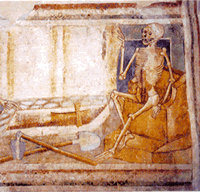
On the south wall
of the side aisle there is a representation of Death Dance.
The pageant of living humanity and the dead contains eleven
skeletons, moving from east to west, in the direction of
the setting sun. There, at the end of the line sits a skeleton,
in a desolate and bleak winter landscape, on a crude stone
throne. As the Goddess of Death and Transformation, the
skeleton holds a gravestone tablet over an open grave, as
if to invite the humans to proceed on the path to the grave.
The Goddess of Death and Transformation rules over the winter,
when life withdraws into its phase of decay and renewal.
In the church of Hrastovlje the procession of the dead is
beckoning mankind into the depth of the grave, that is,
onto the fearsome path through the underworld - to submit
to the process of transformation, which will lead through
death into a renewed beginning.
The hidden threefold Goddess flows in Hrastovlje from the
springtime sun of Virgin Mary, past the summer sun of Mother
Eve, back to the winter sun of the Goddess of Transformation. |
|
Goddess
of Transformation represented as
Death receiving mankind into the Underworld.
|
|
From The Return of the Goddess
by Marko Pogacnik
(Ljubljana 1993)
Translated and adapted by Aleksandra Ceferin, Thezaurus
|
|