In
the chapter Carniolan and Slavic language, Valvasor writes
about the extent and spread of “Slavic” language, which
is ”spoken from Venice in the west to Sweden in the north,
Constantinople in the south and Moscow in the east”.
He identifies two scripts used by
Slavs, Cyrillic and Glagolitic and provides a table of both
scripts, with examples of Slovenian words in Latin script illustrating
each letter.
While
the table is very clear and well executed, Valvasor is less clear
on the origin of the Glagolitic script, ascribing it to St. Hieronimus.
He
is much clearer when it comes to discussing the extent of its
use. He tells us that it is firmly entrenched in Croatia and Dalmatia,
that the Missals in Glagolitic script are printed in Rome and
the language of the church offices is Slavic.
In Carniola (most of present day Slovenia), according to Valvasor,
both the Glagolitic script and “Carniolan” or “Slavic”
language are still used “in many places”. This may mean
either the 17th century spoken Slovenian or Old Church Slavic,
the language of the religious texts as translated by Constantine
and his disciples, or probably both.
Valvasor further tells us, that the Glagolitic script is
no longer as widespread as it used to be, since the “learned
Lutheran preacher Primozz Trubar invented the writing of
Carniolan or Slavic language with Latin letters”(1551 A.D).
He adds that Croats and Dalmatians are also increasingly using
the Latin script.
Valuable
information from Valvasor who is the main 17th century source
for Slovenian territories, on matters which were generally of
little concern to historians. A valuable insight into historical
process which caused the appearance of Glagolitic script and later
its decline.
|
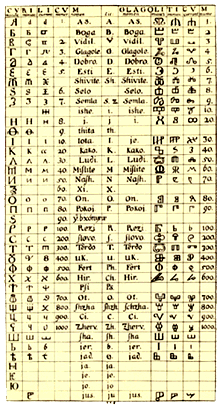
Table of Cyrilic and
Glagolitic Script
from Valvasor's In Praise of Dutchy of Carniola

|