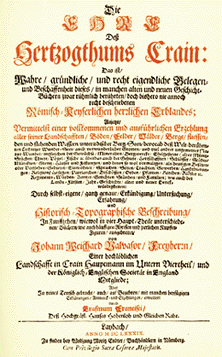
The monumental ethnographic work on the land and
its people
In Praise of the Duchy of Carniola
is comprised of 15 books, of 3532 A4 pages, bound into 4 parts;
with 528 illustrations and 24 supplements. In it the author describes
in detail, as he says,"after painstaking investigation, research
and experience"regions, valleys, fields, forests, mountains,
flowing and standing waters, underground mountain lakes, particularly
the miraculous Cerknica Lake, marvellous caves and many other
unusual natural wonders, also plants, ores, mines, precious stones,
old coins, animals, birds, fishes, etc., counties, great estates,
castles, cities, towns, border fortresses, and their past and
present owners and superiors, commanders, inhabitants, languages,
customs, apparel,
Trades, occupations, religion, saints,
patriarchs, bishops, religious orders, parishes, churches, monasteries,
offices, courts, professions and families; also dukes, yearbooks,
and old and new attractions.
Of particular value. is the section
on Ljubljana, which is the first complex history of the city.
The other important contribution is a detailed description of
the functioning of the intermittent
Cerknica Lake.
|
|
|
It is mainly due to his
work In Praise of the Duchy of Carniola, that Valvasor
has been called Slovenia’s Renaissance man (Lonely
Planet Guide), our great polymath, a chronicler of
his time, an exceptional humanist (Slovenian Magazine
No1 1994). In his scientific method he was ahead of
his time, in attitudes and judgements he did not see
beyond his environment and era of which he was a product.
His greatest achievement is that he does not only
see the great events, the castle and the church but
he lovingly and with great interest describes the
lives and customs of the common people. He is interested
in everything that he sees, the rich tapestry of life
that makes this land what it is. The past and the
present, the natural wonders, the common and uncommon
phenomena of life and nature, the beliefs, superstitions
and archival records of events.
We find it surprising
when he speaks of the origin of the Slavic peoples
and when he presents us with a table
of cyrillic and glagolitic (old Slavic) script.
In the words of Branko
Reisp (Dvanajst velikih Slovencev) about the Valvasors
last and most significant work:
Hardly any country of
the time has been able produced such a work. With
the description of Carniola the central Slovenian
region, Valvasor presented a comprehensive view of
today’s Slovenia and her neighbours in the second
half of the 17th century, during the break between
two historical periods, when religious battles finished
and the Turkish danger was finally averted and life
started to flow at an even pace with the promise of
progress. So it was that the leading work of Slovenian
historiography and a historical source was written,
a rich treasury of information, an encyclopedia of
Slovenia, not attempted for another 300 years.
 
|
|
|