|
Freising
Manuscripts (Brizzinski rokopisi)
The
three oldest Slavic manuscripts - 972 to 1022 AD
Brizzinski
spomeniki, also known as Freisinger Monuments are thousand-year
old manuscripts written in Slovenian language of the time. They
are part of a church codex – most probably used by the bishop
of Freising himself - consisting of 169 pages and containing 70
items in Latin. Of these nine pages - three complete texts - are
written in Old Slovenian presumably spoken in the area during
the 10th century. The preserved Brizzinski spomeniki
are thought to be copies of even older 9th century
originals in Upper Carinthia or in Freising in the territory of
the present day Austria and most probably written by German and
possibly Slovenian priests for their flock.
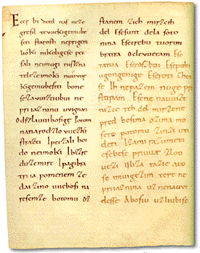 The
Brizzinski spomeniki consist of three texts. Brizzinski spomeniki
I, and Brizzinski spomeniki III are translations of unidentified
Old High German confession formulas. The first text was repeated
after the priest in fragments in what has been liturgical practice
to the present day, the second manuscript is a homily on sin and
its consequences for mankind. The
Brizzinski spomeniki consist of three texts. Brizzinski spomeniki
I, and Brizzinski spomeniki III are translations of unidentified
Old High German confession formulas. The first text was repeated
after the priest in fragments in what has been liturgical practice
to the present day, the second manuscript is a homily on sin and
its consequences for mankind.
On the basis of the script preserved
in the documents, it is possible to determine the precise period
of the origin of Brizzinski spomeniki II and Brizzinski spomeniki
III, which were written between May 972 and the year 1000. The
Brizzinski spomeniki I came into being later, most probably around
1022 or 1023.
The Brizzinski spomeniki have been known for nearly 190 years.
Joseph Docen found the manuscripts in 1806 in one of the volumes
acquired by the Munich National Library from the nearby Freising
Diocese. Without fully realising their value, he placed them linguistically
in the interest sphere of the present day Slovenian language speakers,
recognising it as "the Carynthian or Illyrian dialect".
The name Freising was translated into Slovenian as Brizzinj in
1854 and so the name Brizzinski spomeniki.
The codex was not distinguished for its quality, both the paper
and ink were quite ordinary. However it soon became clear that
the codex was remarkable precisely because of its non-Latin texts,
which are not only the oldest preserved writing in Slovenian but
the oldest Slavic manuscript in general. Joseph Dobrovsky, the
greatest and most distinguished linguist of his period, was among
the first Slavists to see the texts. He copied them and sent the
first text to Baron Ziga Zois in Ljubljana in recognition of its
importance for Slovenes. Dobrovsky’s letter which reached
Ljubljana in September 1812, indicates clearly that the Slovenian
identity of the Brizzinski spomeniki was never in question among
the scholars. Zois failed to publish the find, so generously yielded
by Dobrovsky. However the first texts, Brizzinski spomeniki 1
were published by a Slovene , Jernej Kopitar, in 1822, while all
three texts were published together in 1827 in Saint Petersburg
by Peter Ivan Koepen.
|
|
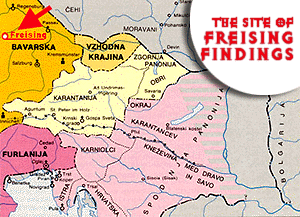
Distribution of Slavs in Europe in 9th century,
the period when the Brizzinski rokopisi originated
(from Enciclopedia populare Pompa, 6th edition,Torino)
|
The texts comprise some
1014 words and are logically divided into three distinct volumes
or "monuments". They were written in the miniscule script
of the German scribal centres at the threshold of the 11th
century which had developed from the Carolingian miniscule, a
script without capital letters.
The language in which
Brizzinski spomeniki are written a thousand years ago shows many
characteristics which confirm continuity to the present day Slovenian.
There are also many differences, not just in vocabulary, but also
in some phonetic structures of both vowels and consonants.
The most recent edition of the Brizzinski spomeniki was prepared
in 1991 by the Institute for Slovene Literature and Literary Sciences
of the Slovene Academy of Sciences and Arts, presenting in single
volume the sources and material behind various scholarly illuminations.
This edition includes transcriptions, translations, speech reconstructions,
bibliographies, synthetic surveys, and a very precisely printed
colour facsimile. A second edition was published in 1992, differing
from the first only in a less elaborate facsimile.
|
| Brizzinski
spomeniki are a remarkable historical document, important
in establishing the place of Slovenian people and culture
within the existing European civilization, and a matter
of national pride. In words of Jozze Faganel: "From
the same period, the Italians, a nation that supposedly
preserves most of the cultural wealth off the world
can only show an introductory sentence in a list of
landowners in the famous Monte Cassino document."
From: The
Brizzinski Spomeniki - Elements of National Self-Confidence,
by Jozze Faganel (Slovenija Magazine, 1995, No.2 Vol.
IX)
|
|

|
|
|
|