|
The
Sticna Abbey
The economic and cultural centre of Lower Carniola since 12th Century
The Cistercian monastery was
established in 1135 and became within decades the religious, economic,
educational and cultural centre of Lower Carniola (Dolenjska). For
a period of time it surpassed in influence and standing Ljubljana,
the capital of Slovenian territories.
|
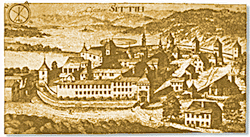
Sticcna Abey from Topographia
Decatus Carnioliae Modernae (1679)
|
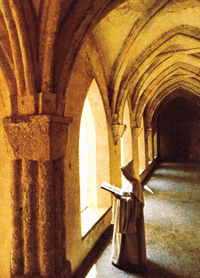
The unique early gothic cross corridor (krizzni hodnik)
|
The monastery was also a centre of learning, famous for its production
of manuscripts from the second half of the 12th century.
The monks produced the largest and oldest collection of Latin manuscripts
on Slovenian territory. In the beginning of 15th century
the famous Sticcna manuscript in Slovenian language was written
, comprising prayer before sermon, the prayer Hail, O Queen, two
formulae for general confession, some Latin-Slovenian phrases and
the beginning of Easter song The Lord rose from death. This manuscripts
was followed by other religious texts in Slovenian language, clearly
demonstrating the ethnic identity of some monks and their care for
their Slovenian flock. So the Sticcna monastery became one of the
few places where Slovenian language was cultivated, beside the prevalent
Latin and German of the ruling and educated classes.
As an educational institution, the
monastery offered theological studies, serving principally the
preparation for priesthood. There was also a school of music,
where the 16th century Slovenian composer Jacobus Gallus
may have been educated.
|
| The monastery
also incorporated an early version of a medical school, where knowledge
of healing properties of herbs and herbal treatments was pursued
and handed down. The pharmacy which they established achieved wide
renown and is still in existence today.
The Cistercian brothers also trained
the surrounding populace in progressive farming methods –
and the Abbey may be regarded as significant precursor of the
19th century Agricultural College at Grm in Lower Carniola.
Their endeavours included the extension of cultivated land, introduction
of the iron plough, improved agricultural tools and development
of new varieties of cultivated fruits and cereals. They built
roads and bridges and offered food and shelter to travellers,
thus facilitating travel and stimulating commercial activities.
According to Slovenian art historian
Marijan Zadnikar, Sticcna Abbey is also one of the most significant
cultural munuments on Slovenian territories. Besides many works
of art – paintings and statues commissioned by various abbots,
it has a Renaissance basilica with the remarkable ground plan
of five apses and the unique cross corridor (krizzni hodnik) -
the only one of its kind. Marijan Zadnikar wrote that it is one
of the greatest eshetic experiences offered among Slovenian cultural
monuments.
|
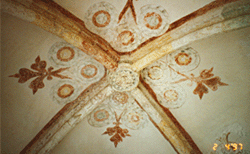
The detail on the ceiling of the cross corridor
|
At present the Sticcna Monastery is still occupied by the monks
who are assisted in their work and continuing functioning of various
workshops by lay people. The monastery has been opened to the public
as a museum, which has a curator whose role is to care for the interiors,
initiate the necessary upgrading and prepare exhibitions. Links:
For the visitor, Sticcna Monastery
offers a unique experience - a walk into the centuries-old past,
productive and prosperous, with all the riches and beauties reflected
in its marvellous building complexes, well maintained and decorated
interiors and works of art.
|
|
From, Stisska Opatija (Sticcna 1981) by Anton Nadrah
Translated by Aleksandra Ceferin
Links:
Sticcna
monastery
|
|